LVT vs laminate for Derby kitchens: which flooring suits your home?
Choosing between LVT and laminate for your kitchen in Derby? We break down durability, water resistance and practicality to help you decide.
LVT vs laminate in a Derby kitchen: the honest comparison
Kitchens are hard on floors. Spills, dropped pans, muddy boots coming in from the garden, chairs scraping back and forth at the table. If you are weighing up LVT vs laminate for your kitchen in Derby, the room's daily demands should be at the top of your thinking, not just how the floor looks in a showroom photograph.
Both options are popular, both look great, and both are a step up from tired old vinyl sheet or worn-out tiles. But they are not the same, and the difference matters most in a kitchen. Here is our plain-spoken guide to help you choose.
What is LVT flooring?
LVT stands for luxury vinyl tile. It is a multi-layer synthetic flooring product, typically made up of a wear layer on top, a printed design layer in the middle and a rigid or semi-rigid core underneath. The design layer can mimic wood, stone, concrete or almost anything else convincingly well.
The key thing to understand about LVT is that it is fully waterproof through its entire construction. Water cannot get into it. That makes it fundamentally different from laminate, which has a high-density fibreboard (HDF) core that will swell and warp if moisture gets in. In a kitchen, that distinction is significant.
LVT also has a softer, slightly warmer feel underfoot compared to laminate. It has a little give to it. That is partly why it is popular in kitchens and dining rooms, where people stand for long periods cooking or eating.
We have fitted LVT in kitchens and dining rooms across Derby and the surrounding area, and it consistently performs well in those spaces.
What is laminate flooring?
Laminate is a wood-effect flooring made from a compressed HDF core with a photographic layer on top, sealed with a tough wear layer. It is hard, stable and looks fantastic in living rooms, hallways and bedrooms. The planks click together, it goes down quickly and it is easy to keep clean with a dry or slightly damp mop.
The limitation in a kitchen is moisture. Laminate is water-resistant on the surface, but it is not waterproof. A spill you mop up quickly is fine. Persistent damp, a slow leak under the dishwasher, or condensation getting into the joints over time? That is where laminate can start to let you down. The HDF core absorbs moisture and the planks can buckle.
That does not mean laminate is a bad product. It is excellent in the right place. We fit laminate regularly in living rooms, hallways and bedrooms across Derby homes, and it looks brilliant in those spaces. But the kitchen is where you need to think carefully.
For more on where laminate really shines, have a read of our guide to laminate flooring for living rooms and hallways in Derby homes.
Durability: which one lasts longer?
Both LVT and laminate are hard-wearing day to day. Neither is fragile. But the question of durability in a kitchen comes down to two things: scratch resistance and moisture resilience.
Scratch resistance. Laminate generally has a very tough wear layer and can be quite scratch-resistant on the surface. LVT also has a wear layer, and the thickness of that layer determines how well it holds up to scratches and scuffs. A thicker wear layer on LVT means better long-term performance. In general, both cope well with normal kitchen use.
Moisture resilience. This is where LVT wins clearly. Because LVT is waterproof by nature, it can handle the kitchen environment without the risk of swelling or warping. Laminate can be damaged by sustained moisture exposure, even with a water-resistant surface coating.
If you have a busy household, children, pets, or simply a kitchen that sees a lot of action, LVT is the more forgiving choice.
Comfort and feel underfoot
LVT has a slight softness to it, especially products with an attached underlay. If you spend a lot of time on your feet in the kitchen, that small amount of give makes a real difference over the course of a day.
Laminate is harder and more rigid underfoot. It can feel a little cold and hollow in some properties, particularly older Derby terraces and semis where subfloors are not always perfectly flat. That said, a good quality underlay beneath laminate improves both comfort and sound.
How they look
Honestly, both look excellent today. The print technology used in both LVT and laminate has come on enormously, and a well-chosen plank in either material can look very convincing as a wood or stone effect.
LVT tends to offer more variety in format, including tile shapes that work well in kitchens and kitchen-diners. Laminate is almost always plank format, which suits longer rooms and open-plan spaces particularly well.
The right choice often comes down to the specific room, the direction of the light and what you are connecting the kitchen to. If your kitchen opens into a living room where you already have laminate, you might want to continue that floor through for a seamless look, or choose an LVT that complements it.
What about the kitchen-diner?
Kitchen-diners are common in Derby homes, particularly in semis and new-builds, and they present an interesting challenge. The kitchen end needs to handle spills and moisture. The dining end is less demanding. LVT handles the whole space comfortably.
We recently fitted LVT through a kitchen and dining room for a customer in the area, and it worked beautifully as a continuous floor across both zones. No joins, no transitions, no visual break. The result looked clean and cohesive.
For more on LVT in dining spaces, take a look at our article on LVT flooring for dining rooms: style, durability and easy cleaning.
What our customers say
One of our customers, Alison, summed up the experience of choosing and fitting new dining room flooring with us:
Really pleased with our new dining room flooring. Curtis was really helpful when it came to bringing samples round and fitting us in. Couldn't be happier with how it's turned out!
That is exactly how we like to work. Bring the samples to you, take the time to understand the room, and fit everything properly so the result speaks for itself.
Preparing your floor for LVT or laminate
Whichever you choose, the subfloor matters. LVT and laminate both need a clean, dry and level surface to go down properly. Any high spots, dips or damp will affect the finished result and the long-term performance of the floor.
In older Derby properties especially, it is worth checking the subfloor condition before committing to a product. We always assess this as part of the job. A little preparation work beforehand makes a big difference to how the floor looks and how long it lasts.
Our guide on how to prepare your Derby home for new carpet or flooring walks through what to expect in more detail.
Frequently asked questions
What is LVT flooring and how does it differ from laminate? LVT (luxury vinyl tile) is a fully waterproof synthetic flooring with a multi-layer construction. Laminate is built around a compressed wood-fibre core with a photographic surface layer. The main practical difference is that LVT handles moisture without risk of damage, while laminate can swell if water gets into the joints or the core. Both look great, but LVT is the safer choice for kitchens.
Is laminate or vinyl (LVT) more durable? Both are durable for everyday use. Laminate can be very tough on the surface and resists scratches well. LVT's durability depends on the wear layer thickness. In a kitchen specifically, LVT tends to be more durable overall because it is not vulnerable to moisture damage the way laminate is. For dry areas like living rooms and bedrooms, laminate holds its own very well.
Does LVT scratch easily? LVT has a protective wear layer that resists everyday scuffs and scratches. The thicker the wear layer, the better the protection. In a kitchen with normal use, good-quality LVT holds up well. Heavy dragging of furniture or sharp objects can mark any floor, so using felt pads on chair and table legs is always sensible.
Which is better for a kitchen-diner: LVT or laminate? For a kitchen-diner, we would generally recommend LVT. It handles the moisture risk at the kitchen end while looking just as good across the dining area. It also works well as a continuous floor across both zones without needing a break or transition strip. Laminate can work in a kitchen-diner if moisture risk is managed carefully, but LVT gives you more peace of mind.
Ready to choose your kitchen floor in Derby?
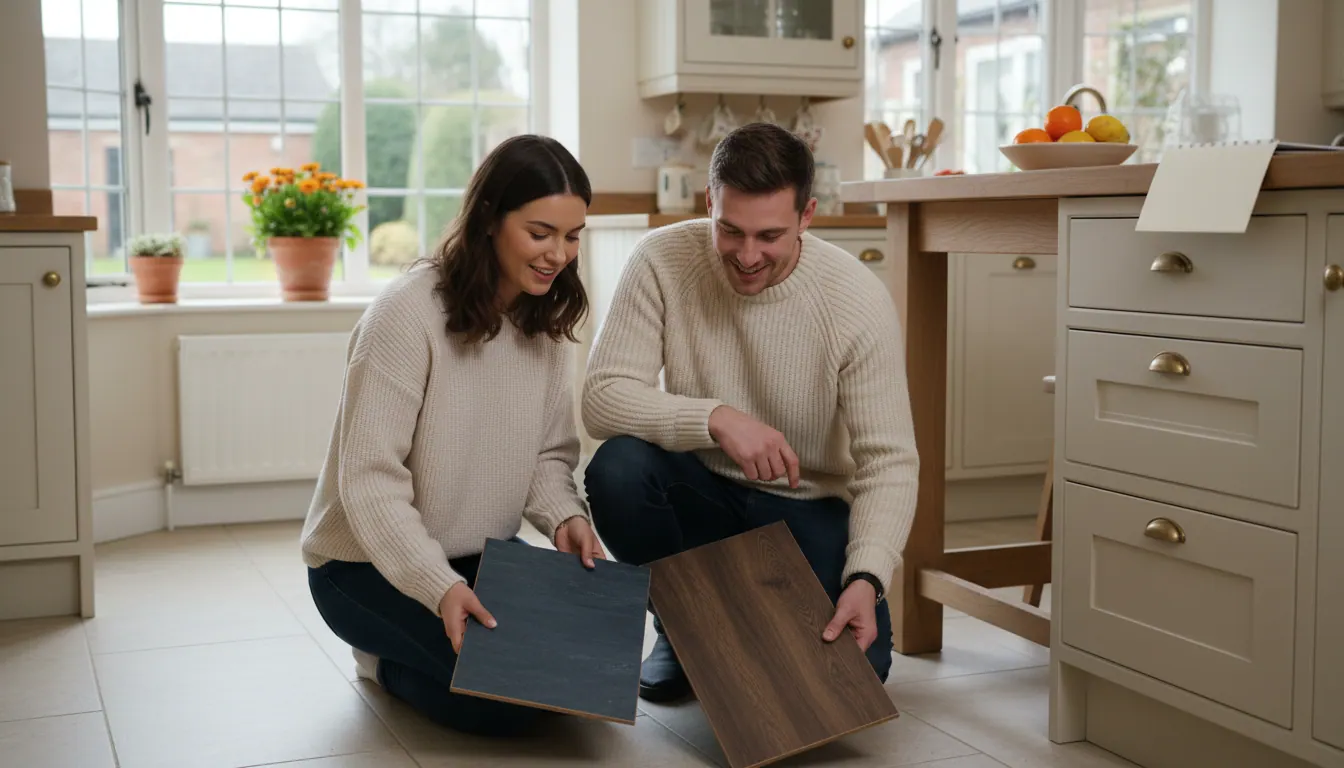
If you are still not sure which direction to go, the best thing is to have a proper look at samples in your own room, in your own light. We can talk through the options with you and help you make a decision you will be happy with for years to come.
Call us on 07306 114151 or get in touch through the website to arrange a chat. No pressure, just honest advice and a proper fitting job done right.